1. The export picture: solid growth, but Halal is still untapped
According to the Vietnam Association of Seafood Exporters and Producers (VASEP), seafood exports in the first nine months of 2026 reached USD 9.103 billion, up 11.4%. Shrimp brought in USD 3.75 billion, pangasius USD 1.74 billion and tuna USD 716 million. ASEAN reached USD 620 million, up 21%, one of the bright spots. VASEP is targeting around USD 12 billion for the full year, although growth is forecast to slow in the fourth quarter.
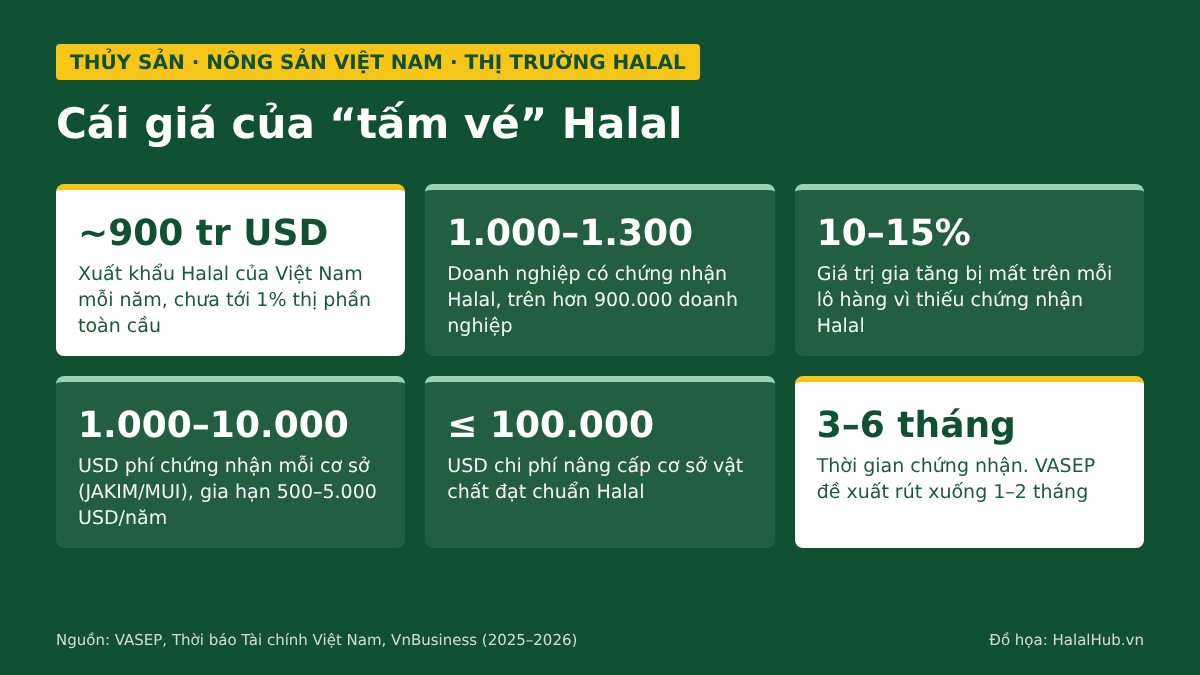
From a Halal perspective, according to Vietnam Financial Times, Vietnam’s Halal exports amount to only about USD 900 million a year, mostly raw farm and seafood products, less than 1% of the global market. Between 2024 and 2026, only around 1,000–1,300 businesses obtained or maintained Halal certification, out of more than 900,000 active businesses. A seminar reported by VnBusiness (May 2026) estimated that Vietnamese firms lose 10–15% of added value on every shipment to Muslim markets for lack of certification.
2. The price of the Halal “ticket”
According to figures published by VASEP in 2025, obtaining Halal certification from bodies such as JAKIM (Malaysia) or MUI (Indonesia) can cost USD 1,000–10,000 per facility, plus renewal fees of USD 500–5,000 a year. If a plant has to be upgraded with dedicated Halal-compliant areas or lines, the investment can reach USD 100,000. Certification usually takes 3–6 months; MUI’s process for a new applicant alone can take 3–4 months.
⚠️ A NOTE ON THESE FIGURES
The costs above were published by VASEP in 2025 and are indicative only. Actual costs depend on the certification body, the size of the plant, the number of products and the target market. Businesses should get quotes from at least 2–3 bodies recognised by the importing country before deciding.
At the time, VASEP proposed setting up a national Halal certification body recognised by JAKIM and MUI, aiming to cut certification time to 1–2 months and to negotiate mutual recognition with other ASEAN countries.
3. From proposals to action: what has changed
- The National Halal Certification Centre (HALCERT) has been operating since April 2024.
- Decree 127/2026/ND-CP on quality management and development policies for Halal products and services took effect on 1 June 2026.
- Five Vietnamese certification bodies are recognised by JAKIM (as of 21 August 2026), the third-highest number in the world.
- The Ministry of Science and Technology plans to develop 17 new Halal standards under the sector development scheme to 2030.
- On 13 October 2026, STAMEQ met the Malaysian Embassy to discuss cooperation on certification and mutual recognition.
Even so, an MRA with Indonesia is still the missing piece. From 18 October 2026, processed seafood exported to Indonesia must carry Halal certification accepted by BPJPH. Since 9 September 2026, every shipment must also pass a pre-shipment inspection.
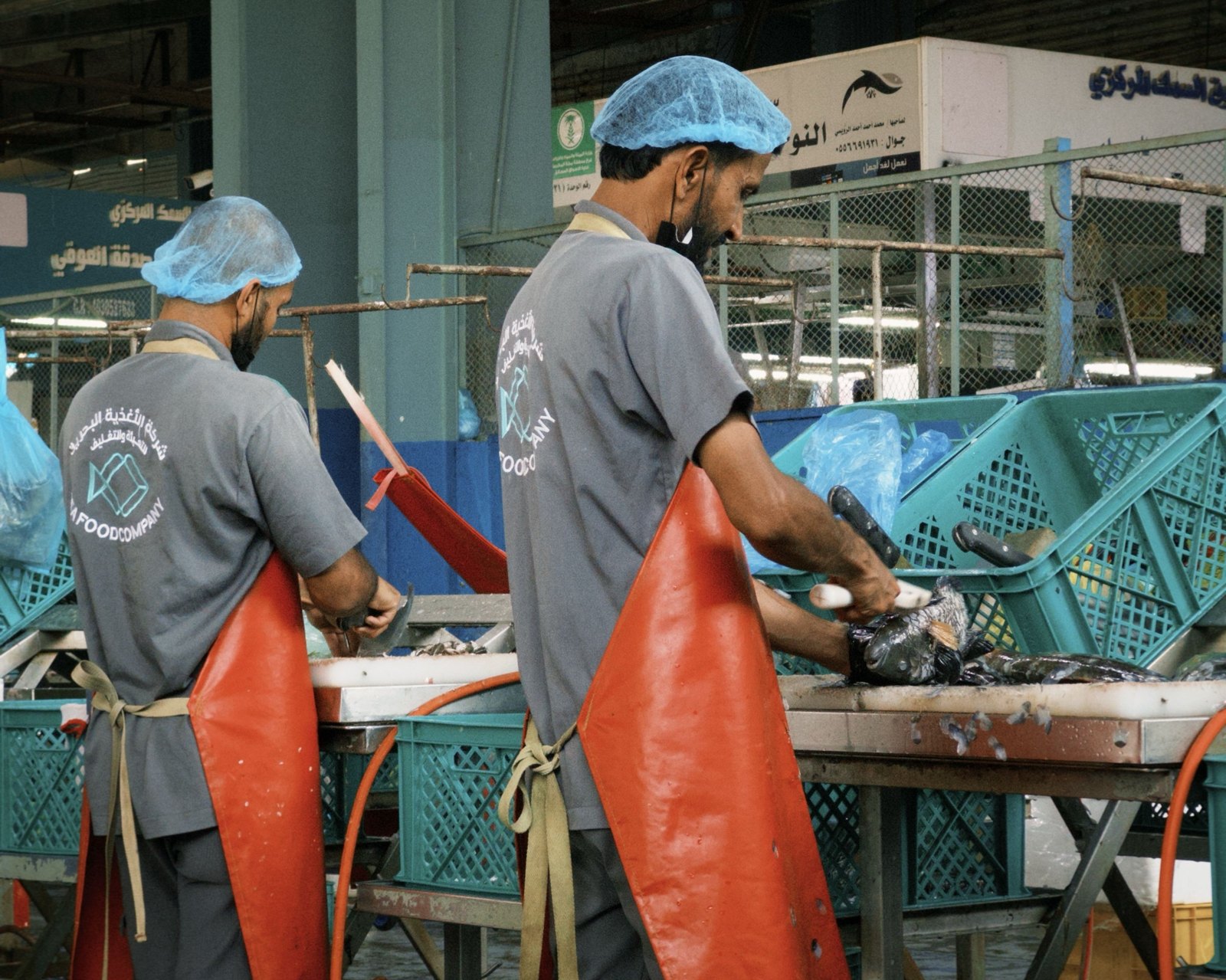
4. Does seafood need Halal certification? Common risk points
Many businesses assume seafood is “Halal by default”. In practice, most Islamic schools of thought accept the majority of seafood, but schools still differ on some species. More importantly, Halal certification assesses the whole process, not just the main raw material. Common risk points include:
| Stage | What to control |
|---|---|
| Additives, seasonings | Emulsifiers, flavourings, gelatin and enzymes of animal origin or containing alcohol; sauces and marinades |
| Batter, marinating | Ingredients of breadcrumbs and batter; frying oil shared with non-Halal products |
| Lines, equipment | Lines shared with products containing pork or alcohol without an approved cleaning procedure |
| Cleaning chemicals | Detergents and disinfectants with non-Halal ingredients |
| Packaging, cold storage | Storage and transport alongside non-Halal goods; labels and Halal marks that do not meet target-market rules |
Source: HalalHub.vn, compiled from the general requirements of Halal certification systems. The specific control list is set by the certification body.
5. A 5-step roadmap for seafood businesses
- Choose the market first: Malaysia (with five JAKIM-recognised Vietnamese bodies) is the easiest door; Indonesia requires certification accepted by BPJPH plus inspection of every shipment; the Gulf requires a body registered with MoIAT or SFDA.
- Classify your products: separate fresh and whole frozen products from processed and marinated ones. Processed products carry more risk points and should be handled first.
- Review all secondary ingredients: ask suppliers of additives, seasonings and batter for their Halal certificates.
- Set up a Halal Assurance System (HAS): cleaning and segregation procedures, training, and a designated Halal officer. Build on existing HACCP or BRC systems to keep costs down.
- Compare quotes and lead times from 2–3 bodies recognised by the importing country, then plan for annual renewal.
✅ THE HALALHUB VIEW
Halal certification should be seen as an investment in selling at the right price, not just a compliance cost. With 10–15% of added value currently lost on every shipment, a mid-sized seafood plant could recover its certification costs after just a few shipments to the right market.
🛒 HALALHUB.VN – THE GATEWAY FOR VIETNAMESE GOODS INTO THE GLOBAL HALAL MARKET
Seafood importers in Malaysia, Indonesia and the Middle East are looking for suppliers with Halal certification and transparent traceability records.
Open a storefront on HalalHub.vn to present your products, certificates and production capacity to international buyers. Register now at https://halalhub.vn
Glossary
- VASEP: Vietnam Association of Seafood Exporters and Producers.
- JAKIM: Department of Islamic Development Malaysia, which issues and recognises Halal certification in Malaysia.
- MUI (Majelis Ulama Indonesia): the Indonesian Ulema Council, which issues fatwas (religious rulings) on Halal. MUI used to issue certificates directly; BPJPH is now the issuing authority.
- BPJPH: Indonesia’s Halal Product Assurance Agency.
- HALCERT: Vietnam’s National Halal Certification Centre.
- HAS (Halal Assurance System): the Halal assurance system a business maintains at its plant.
- HACCP / BRC: international food safety management systems that can serve as a foundation for a HAS.
- MRA: mutual recognition agreement on certification.
- MoIAT / SFDA: the UAE’s Halal regulator / the Saudi Food and Drug Authority.
References
- Doanh nghiep va Tiep thi – Seafood exports exceed USD 9.1 billion in nine months (Vietnamese)
- Thanh tra – Seafood exports pass USD 9 billion as shrimp and pangasius stay in the lead (Vietnamese)
- Vietnam Financial Times – Expanding export room in the Halal market (Vietnamese)
- VnBusiness – Vietnamese businesses at the Halal “golden door”: going far means solving the trust problem (Vietnamese)
- Thuy san Viet Nam – Lacking a Halal certification body, Vietnamese seafood is at a disadvantage in ASEAN (Vietnamese)
- Government News – Ministry of Science and Technology to develop 17 new Halal standards (Vietnamese)
- Vietnam News – Việt Nam has five Halal certification bodies recognised by Malaysia
- Nation Thailand – Indonesia halal deadline puts Thai food exporters on clock
Photos: Unsplash (Unsplash licence). Graphics: HalalHub.vn.