1. A large market, a ready supply
According to an analysis by Le Nguyen Thien Nga, Director of the Institute of Policy Governance and Development Strategy, published in Hanoi Moi (19 October 2026), spending across the sectors of the Halal economy reached about USD 2.6 trillion in 2024 and is forecast to rise to about USD 3.56 trillion by 2029. The article highlights Vietnam’s strengths in rice, coffee, tea, cashews, pepper, fruit and vegetables, and seafood.
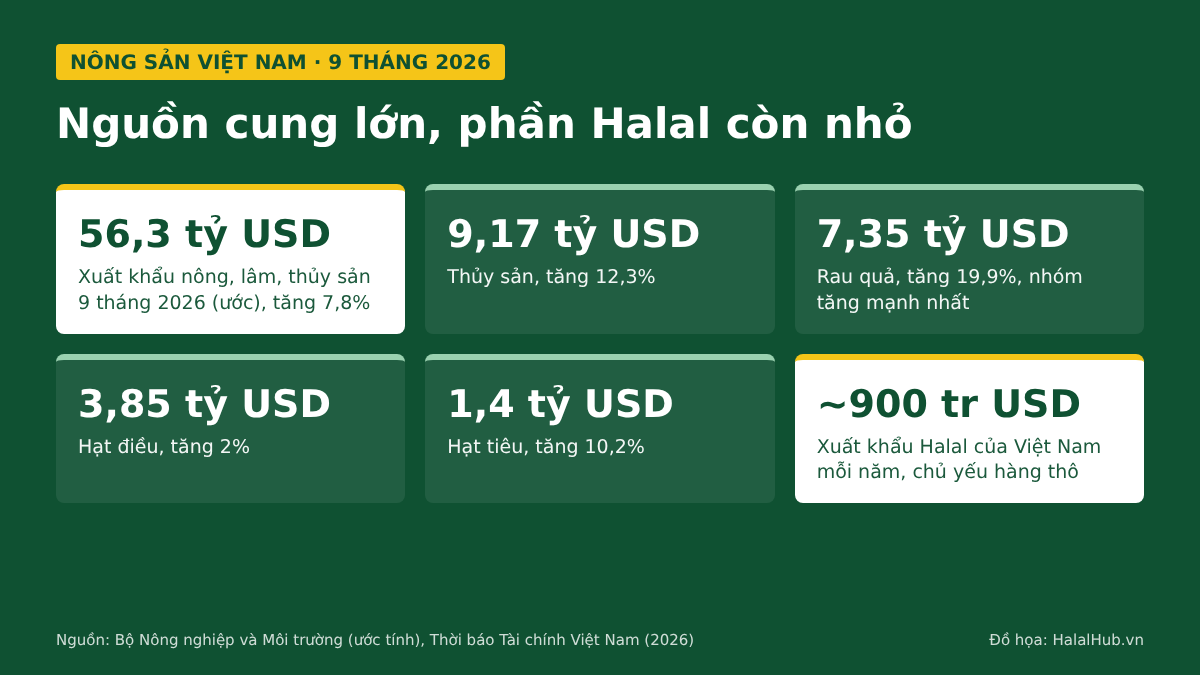
On the supply side, according to estimates by the Ministry of Agriculture and Environment, agricultural, forestry and fishery exports in the first nine months of 2026 reached about USD 56.3 billion, up 7.8%. Of this, seafood reached USD 9.17 billion (+12.3%), fruit and vegetables USD 7.35 billion (+19.9%), cashews USD 3.85 billion (+2%) and pepper about USD 1.4 billion (+10.2%). Rice was the one group that fell, to USD 3.11 billion (−10.9%).
2. The gap: a large supply, a small Halal share
According to Vietnam Financial Times, Vietnam’s Halal exports amount to only about USD 900 million a year, mostly raw farm and seafood products, less than 1% of the global market; only around 1,000–1,300 businesses have obtained or maintained Halal certification. In other words, farm produce entering Halal markets with clear certification is only a small part of total export turnover.
At the trade promotion briefing on 23 September 2026 (according to Nhan Dan), supply capacity and coordination mechanisms to boost Halal exports were among the topics discussed. One notable point raised by many experts is that Vietnam needs to build a stable supply system for Halal raw materials, rather than focusing only on certifying the final product.
📌 KEY POINTS
Supply: USD 56.3 billion of agricultural, forestry and fishery exports in the first nine months of 2026 (estimate).
Halal share: about USD 900 million a year, mostly raw goods.
Bottlenecks: certification, deep processing and a compliant raw-material supply chain.
3. Each farm product group has its own “Halal problem”
| Product group | Halal complexity | What to control |
|---|---|---|
| Fresh, unprocessed produce (rice, fresh fruit, whole nuts) | Low. Some markets do not require certification for fresh goods | Storage and transport without cross-contamination; coatings and preservative waxes (if any) |
| Semi-processed produce (roasted cashews, pepper, roasted coffee) | Medium | Roasting oil, seasonings, shared lines |
| Processed food (dried fruit, juices, confectionery, spices) | High | Additives, flavourings, emulsifiers, gelatin, alcohol in flavourings |
| Processed seafood | High | Batter, sauces, cleaning chemicals, shared cold storage |
Source: HalalHub.vn, compiled from the general requirements of Halal certification systems. Specific requirements depend on the certification body and the target market.
The table reveals a paradox: the highest value-added product groups have the most complex Halal requirements. This is why Vietnam still mainly exports raw goods to Halal markets, while the processing value goes to businesses in other countries.

4. Building a Halal value chain: start with raw materials
- Choose flagship products and target markets: for example, cashews and dried fruit for Malaysia and the UAE; identify the certification bodies those markets recognise.
- Standardise raw-material areas and suppliers: require suppliers of additives, seasonings and packaging to hold Halal certification; build traceability records.
- Separate production lines or set up an approved cleaning procedure if the plant makes both Halal and non-Halal products.
- Control logistics: warehouses, containers and transport without cross-contamination; many markets are tightening this requirement.
- Link up along the chain: cooperatives, processors and exporters share certification costs instead of each doing it separately.
🔎 A NOTE ON THE INDONESIAN MARKET
On 17 October 2026, the Indonesian government announced it would push back mandatory Halal certification for imported food and beverages to October 2028 (the amending regulation is yet to be issued). Farm businesses should use this time to standardise their supply chains rather than wait for the deadline.
5. Conclusion
A supply advantage is a necessary condition; a compliant value chain is the sufficient one. With more than USD 56 billion of agricultural, forestry and fishery exports every nine months, shifting even a small share from raw goods to Halal-certified processed goods could significantly raise Vietnam’s Halal exports. The starting point is not the final certificate, but raw materials, processes and the links between each part of the chain.
Glossary
- Halal economy: product and service sectors that meet the needs of Muslim consumers (food, cosmetics, pharmaceuticals, fashion, tourism, media…).
- Deep processing: turning farm produce into high value-added products (drying, roasting, packaging finished goods…).
- Cross-contamination: contact between Halal products and non-Halal materials or surfaces during production, storage or transport.
- Traceability: the ability to identify where a product’s raw materials come from and the stages it has gone through.
- JAKIM / MoIAT / BPJPH: the Halal regulators of Malaysia / the UAE / Indonesia.
References
Legal texts and official sources
- Ministry of Agriculture and Environment – estimated agricultural, forestry and fishery exports for the first nine months of 2026 (as reported by VietnamPlus) (Vietnamese)
- Government of Indonesia – announcement of the extended mandatory Halal timeline on 17 October 2026 (as reported by ANTARA) (Indonesian)
Press and industry analysis (secondary sources, cited as published)
- Hanoi Moi (19 October 2026) – Vietnamese farm produce and the opportunity of the Halal market (Vietnamese)
- Vietnam Financial Times – Expanding export room in the Halal market (Vietnamese)
- Nhan Dan – Removing bottlenecks so Vietnamese goods can go deeper into the Halal market (Vietnamese)
- Nong nghiep Huu co – Agricultural, forestry and fishery exports reach USD 56.3 billion after nine months (Vietnamese)
- Dai Doan Ket – Opening the Halal door wider to raise the value of Vietnamese exports (Vietnamese)
Photos: Unsplash (Unsplash licence). Graphics: HalalHub.vn.
HalalHub.vn · Published 20 October 2026 · Legal information checked as of 20 October 2026; regulations may change, so please check official sources before making decisions.
ℹ️ ABOUT HALALHUB.VN’S INDEPENDENCE
HalalHub.vn is a connection and information platform. HalalHub.vn is not a Halal certification body and does not issue Halal certificates. Halal certificates are issued by certification bodies recognised by the competent authority of the importing country (for example, BPJPH in Indonesia, or bodies recognised by JAKIM in Malaysia). This article is for reference only and does not replace legal advice.
HalalHub.vn services
🤝 CONNECT WITH HALALHUB.VN
Businesses with Halal certification: sign up as a member and create a company profile in the HalalHub.vn directory, stating the issuing body, scope and validity of your certificate so partners can assess it easily.
Businesses without certification: follow the News and Knowledge sections of HalalHub.vn for updates on regulations and certification roadmaps for each market.
Register at: https://halalhub.vn