1. Why “one certificate for every market” does not work
In essence, Halal is a system of rules based on Islamic law (Shariah). Commercially, however, each Muslim-majority country manages Halal as a technical barrier, with its own competent authority, standards and list of accepted foreign certification bodies. A certificate valid in Malaysia is not necessarily accepted in Indonesia or the UAE.
The size of the market makes this game worth playing. According to DinarStandard’s State of the Global Islamic Economy 2024/25 report, widely cited in the industry, Muslim spending across the sectors of the Halal economy reached about USD 2.43 trillion in 2023 and is forecast to rise to around USD 3.36 trillion by 2028.
🔑 CORE PRINCIPLE
A Halal certificate is only valid when the issuing body is recognised by the competent authority of the importing country. Before signing a certification contract, businesses must ask: “Is this body on the list of BPJPH / JAKIM / MoIAT / SFDA?”
2. Vietnam: its own “rules of the game” since 1 June 2026
On 6 April 2026, the Government issued Decree 127/2026/ND-CP on quality management and development policies for Halal products and services. According to the Directorate for Standards, Metrology and Quality, the new policies took effect on 1 June 2026. The decree has 6 chapters and 28 articles covering quality requirements, labelling, traceability, testing, Halal certification, inspection and handling of violations.
It applies to businesses that produce, import, export and trade Halal products and services; to testing and certification bodies; and to the relevant state management agencies. Articles 21–23 set out policies to support the development of the Halal market. According to HALCERT, the decree also lays down mandatory principles for certification bodies: transparency, non-discrimination and the application of internationally recognised standards such as those of OIC/SMIIC.
The accompanying technical infrastructure includes the national standard TCVN 13888:2023 on requirements for Halal certification bodies, and the National Halal Certification Centre (HALCERT). HALCERT was launched in April 2024 under the Ministry of Science and Technology.
📌 WHAT IT MEANS FOR BUSINESSES
Decree 127/2026 does not make Halal mandatory for all products. It standardises how certification and management are carried out, thereby laying the groundwork for Vietnam to negotiate mutual recognition agreements (MRAs) with Muslim countries. This is the key condition for “made in Vietnam” certificates to be accepted abroad.
3. Indonesia: the largest market, the narrowest door
Indonesia has the world’s largest Muslim population. Under Law 33/2014 and Government Regulation PP 42/2024, from 18 October 2026, imported food, beverages, cosmetics, dietary supplements and many consumer goods must be Halal-certified. BPJPH Head Ahmad Haikal Hasan has confirmed there will be “no postponement”. Non-compliant goods may receive warnings or be withdrawn from circulation.
The process for imported goods has two steps. First, the product is certified by a foreign body recognised by BPJPH through an MRA. Second, the importer registers that certificate on the SIHALAL system. The current bottleneck is that Vietnam and Indonesia have not yet signed a Halal MRA (according to information published up to early 2026). The BPJPH Head has said that many well-known Vietnamese fast-moving consumer goods lack Halal certification mainly for this reason.
A temporary workaround used by many businesses: obtain certification through a third-country body that already has an MRA with BPJPH, or work directly with BPJPH through the importing partner. Both options add cost and time, which should be factored into pricing.
4. Malaysia: the most open door for Vietnamese goods
Malaysia manages Halal through JAKIM and the MS 1500:2019 standard on Halal food. The big bright spot: according to JAKIM Director-General Sirajuddin bin Suhaimee in an interview with the Vietnam News Agency, as of 21 August 2026, Vietnam has 5 Halal certification bodies recognised by JAKIM, ranking third in the world after Australia and Japan. The five bodies are HCA, HVN, VNH, VINAHIC and GHC.
JAKIM’s list currently includes 96 bodies in 49 countries and territories. Each recognition is valid for 3 years and the list is revised periodically (most recently on 30 January 2026 and 21 August 2026). On the competitive side, Malaysia’s 2027 budget provides a matching grant of up to RM5,000 for domestic SMEs obtaining Halal certification for the first time. Vietnamese goods will have to compete with a strongly supported domestic Halal industry.
✅ SHORT-TERM OPPORTUNITY
Malaysia is currently the most feasible “door”: businesses can get certified right in Vietnam through the 5 JAKIM-recognised bodies, at significantly lower cost and in less time than going through a third country. JAKIM-recognised certification is also a credibility “bonus” when pitching to other markets.
5. UAE and Saudi Arabia: tight control over certification bodies
In the UAE, the Ministry of Industry and Advanced Technology (MoIAT) manages the national Halal system based on the UAE.S 2055-1 standard (compatible with the Gulf’s GSO 2055-1). According to export guides, for meat and poultry, certificates from bodies not on MoIAT’s registered list may be rejected at customs. The UAE national Halal mark is optional but commercially valuable.
In Saudi Arabia, the Saudi Food and Drug Authority (SFDA) requires Halal certification bodies in exporting countries to be designated by the SFDA. As Gulf regulations change quickly and each emirate may have additional requirements, businesses should check the lists directly on the MoIAT and SFDA portals right before every shipment.
6. Quick comparison table
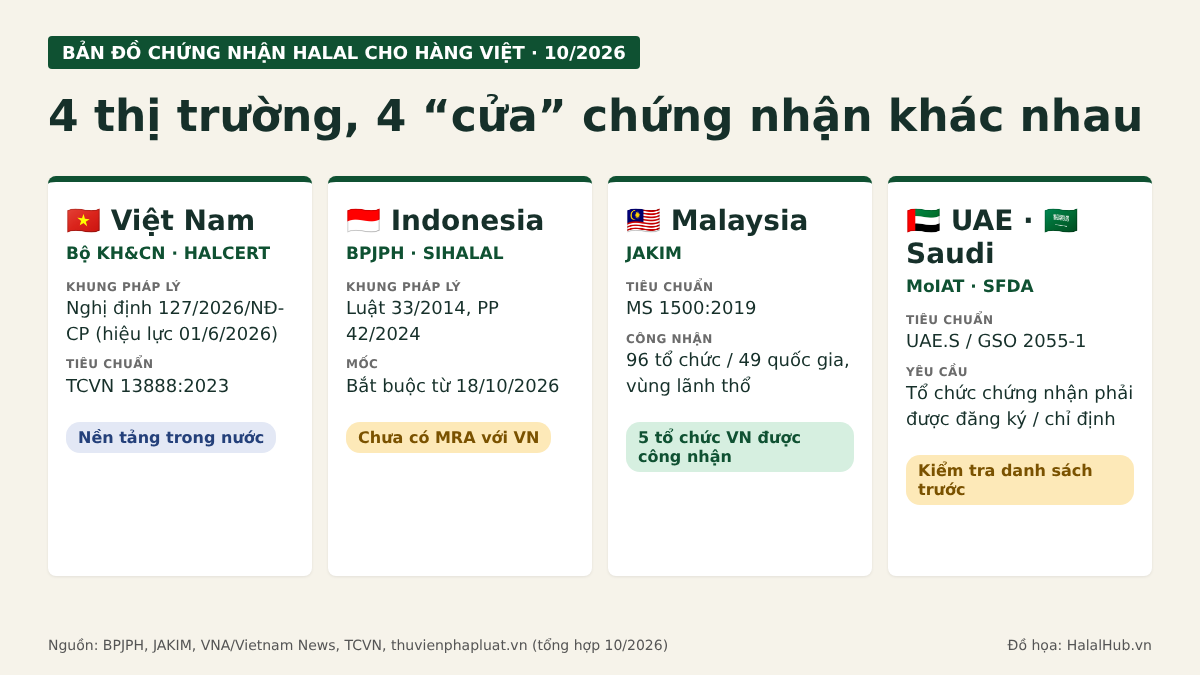
| Market | Competent authority | Legal basis / standard | Requirement for Vietnamese goods | Accessibility (10/2026) |
|---|---|---|---|---|
| Vietnam | Ministry of Science and Technology; HALCERT | Decree 127/2026; TCVN 13888:2023 | Applies to domestic businesses, foundation for MRAs | Legal framework in place |
| Indonesia | BPJPH | Law 33/2014; PP 42/2024 | Body with an MRA with BPJPH + SIHALAL registration | Difficult: no Vietnam – Indonesia MRA yet |
| Malaysia | JAKIM | MS 1500:2019 | Body on JAKIM’s list | Favourable: 5 Vietnamese bodies recognised |
| UAE | MoIAT | UAE.S 2055-1 / GSO 2055-1 | Body registered with MoIAT | Moderate: check the list |
| Saudi Arabia | SFDA | GSO 2055-1 | Body designated by SFDA | Moderate: check the list |
Source: compiled by HalalHub.vn. Information may change; businesses should check the official portals before shipping.
7. A 5-step roadmap for Vietnamese businesses
- Choose your target market first, then the certification body. Check the body’s name against the importing country’s recognition list.
- Review your ingredient supply chain: list all components and require suppliers to provide Halal certificates for high-risk ingredients (gelatine, emulsifiers, enzymes, flavourings, alcohol).
- Build a Halal Assurance System (HAS) at the factory: segregation, sanitation, staff training and an appointed Halal officer.
- Get audited and certified, then work with the importer to register in the destination country (e.g. SIHALAL in Indonesia).
- Promote through the right channels: list certified products on dedicated Halal trade platforms to reach international buyers.
⚠️ RISK WARNING
The market has quite a few “Halal certification” providers that are not recognised by any importing country. Certification from the wrong body means goods rejected at port, a cost far greater than any savings on certification fees.
🛒 HALALHUB.VN – THE GATEWAY FOR VIETNAMESE GOODS INTO THE GLOBAL HALAL MARKET
Regulations differ from market to market, but buyers all look for the same thing: suppliers that are certification-ready and transparent.
Open a storefront on HalalHub.vn to showcase your products and Halal certificates to importers in Indonesia, Malaysia and the Middle East, and get the latest regulatory updates every day. Register now at https://halalhub.vn
Glossary
- Halal / Haram: Arabic words meaning “permissible” and “forbidden” under Islamic law (Shariah).
- HALCERT: Vietnam’s National Halal Certification Centre.
- TCVN 13888:2023: Vietnamese national standard on requirements for Halal certification bodies.
- OIC/SMIIC: Organisation of Islamic Cooperation / Standards and Metrology Institute for Islamic Countries, which issues the OIC/SMIIC Halal standards.
- BPJPH: Indonesia’s Halal Product Assurance Agency. SIHALAL is its online registration system.
- JAKIM (Jabatan Kemajuan Islam Malaysia): Department of Islamic Development Malaysia, the authority that issues and recognises Halal certification in Malaysia.
- MS 1500:2019: Malaysian standard on Halal food (production, preparation, handling and storage).
- MoIAT (Ministry of Industry and Advanced Technology): the UAE Ministry of Industry and Advanced Technology.
- SFDA (Saudi Food and Drug Authority): Saudi Arabia’s food and drug regulator.
- GSO 2055-1 / UAE.S 2055-1: Gulf / UAE standards on general requirements for Halal food.
- MRA (Mutual Recognition Agreement): an agreement on mutual recognition between the Halal authorities of two countries.
- HAS (Halal Assurance System): the Halal assurance system a business must maintain at its production site.
References
- Thư viện Pháp luật – Full text of Decree 127/2026/ND-CP on quality management and development policies for Halal products and services (Vietnamese)
- TCVN – New Halal policies and market development support take effect from 1 June 2026 (Vietnamese)
- HALCERT – Decree 127/2026/ND-CP: a new step in managing and developing the Halal market in Vietnam (Vietnamese)
- BPJPH – Kepala BPJPH Pastikan Implementasi Wajib Halal Oktober 2026 Sesuai Tahapan
- ANTARA News – BPJPH tegaskan tidak ada penundaan implementasi Wajib Halal
- VOV – Indonesia ready to cooperate with Vietnam in halal sector
- Vietnam News – Việt Nam has five Halal certification bodies recognised by Malaysia
- VnEconomy – Malaysia recognises five Vietnamese Halal certification bodies
- New Straits Times – 2027 Budget: RM5,000 grant for first-time halal certification
- American Halal Foundation – Halal Certification in UAE: Export Requirements and Process
- HalalCC – Global Halal Market Size 2026 (citing DinarStandard, SGIE 2024/25)