HalalHub.vn · In-depth analysis · 31 October 2026
(HalalHub.vn) – The seizure of 6.5 tonnes of chicken in Malaysia on 29 October highlights a reality: the greatest Halal risks often arise after a business has obtained certification. This article examines vulnerable points in the chain, the legal framework for post-certification inspections in Vietnam and Malaysia, and six pillars for an internal Halal maintenance system.
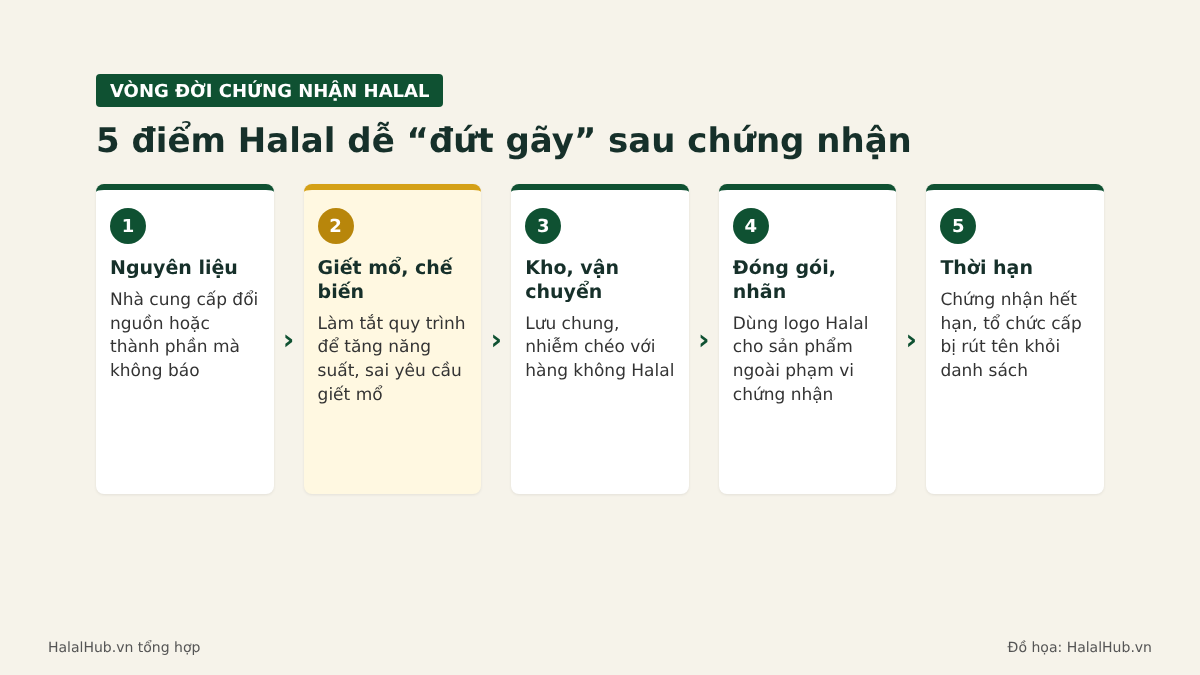
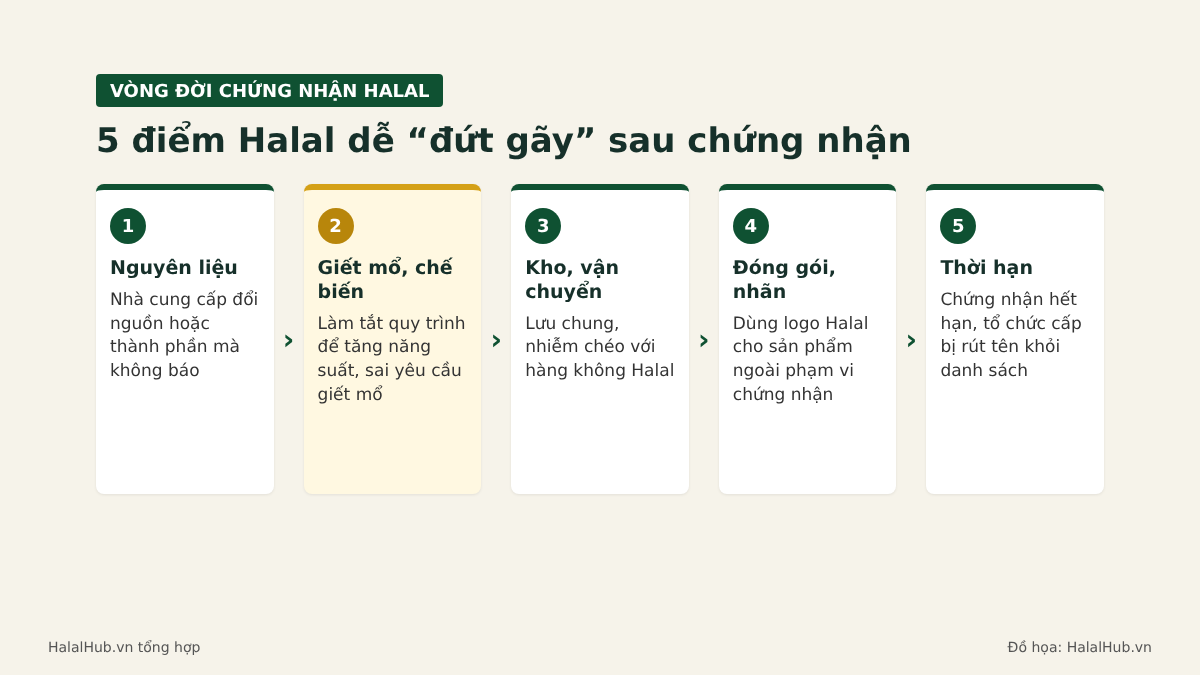
Five points where Halal risks may arise after a business has been certified. Graphic: HalalHub.vn.
1. Certification is a snapshot; maintenance is the whole film
A certification assessment reflects a business’s condition at the time of assessment. Afterwards, suppliers may change ingredient sources, new workers may lack training, or production pressures may lead to shortcuts. These changes do not automatically appear on the certificate, but they can compromise a product’s Halal status.
Malaysian cases in 2026, including Kampung Baru Subang in April, involving non-Halal meat worth around RM1.5 million, and Puchong in October, involving 6.5 tonnes of chicken, indicate increasingly extensive regulatory checks in distribution. For Muslim consumers, one violation can undermine trust in an entire product category rather than just one brand.
2. The legal framework already supports post-certification inspections
| Country or market | Basis for inspection and enforcement |
| Malaysia | Trade Descriptions Act 2011 and Trade Descriptions (Definition of Halal) Order 2011 prohibit false Halal descriptions; JAKIM and state religious departments coordinate inspections. |
| Vietnam | Decree 127/2026/ND-CP, effective 1 June 2026: Articles 17–20 set out inspection content and procedures for producers, traders and Halal certification bodies; the Ministry of Science and Technology may revoke the operating registration certificate of a non-compliant certification body. |
| Importing markets | Foreign certification bodies may be removed from recognition lists such as JAKIM, BPJPH and MoIAT; their certificates then lose acceptance in the relevant market. |
Source: HalalHub.vn, compiled from Decree 127/2026/ND-CP, VASS and Malaysian media. Businesses should consult the original legal texts before implementation.
At the conference implementing Decree 127/2026 in Ho Chi Minh City on 21 October, the key messages were maintaining requirements after certification, verifying suppliers and communicating the correct certification scope, according to Bao Tin Tuc. These are precisely three areas businesses often underestimate.

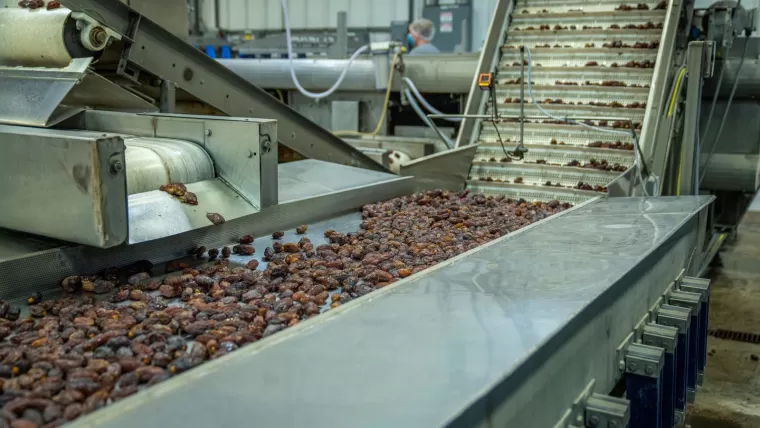
Hygiene, segregation and worker training must be maintained daily, not only during certification assessments. Illustrative photo: Unsplash.
3. Five vulnerable points
Ingredients: suppliers change sources, for example switching from bovine gelatin to gelatin of unknown origin, without notification.
Slaughter and processing: shortcuts to increase output; for poultry, errors in stunning, neck cutting or scalding can cause an entire batch to fail.
Storage and transport: storage alongside non-Halal goods or use of shared refrigerated vehicles that have not been properly cleaned.
Packaging and labels: printing the Halal logo on new products outside the certification scope.
Validity: certificates expire without timely renewal, or the certification body is removed from the destination market’s recognition list.
4. Six pillars of an internal Halal maintenance system
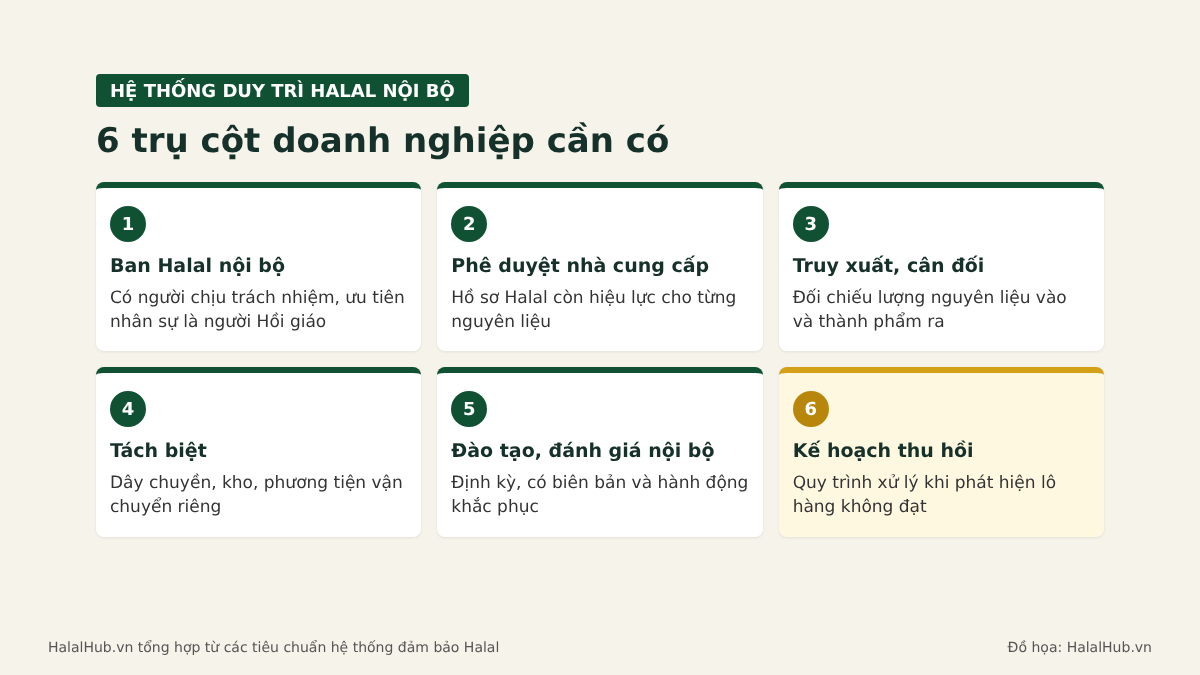
Six pillars of an internal Halal maintenance system. Graphic: HalalHub.vn.
| Pillar | Specific actions |
| Internal Halal committee | Appoint a responsible person, preferably a Muslim staff member, with authority to stop a shipment when concerns arise. |
| Supplier approval | Maintain approved supplier lists and valid Halal documentation for each ingredient; require advance notice of source changes. |
| Traceability and mass balance | Record ingredient and finished-product batches; reconcile inputs and outputs to detect unfamiliar ingredients. |
| Segregation | Use dedicated lines, tools, storage and vehicles, or validated cleaning procedures. |
| Training and internal assessments | Train new hires and conduct refresher training; perform internal assessments at least annually with corrective actions. |
| Recall plan | Establish procedures to notify, isolate and recall affected batches and report deviations to the certification body. |
Source: HalalHub.vn, compiled from general requirements of Halal assurance systems.
| ✅ QUICK SELF-CHECK Does the business know the expiry date of every supplier’s Halal certificate? If a supplier changes an ingredient today, how long will it take the business to find out? Can a finished-product batch be traced back to its ingredient batch within four hours? Does the Halal logo on the packaging match the product list on the certificate? |
5. Conclusion
A certificate opens market access, but a maintenance system preserves it. As importing-country regulators increase distribution-stage inspections and Vietnam has established a legal basis for post-certification checks, investing in an internal system from the outset helps businesses avoid risks far more costly than building the system itself.
Glossary
Halal Assurance System (HAS): the procedures, records and personnel that help a business maintain continuous Halal compliance.
Mass balance: comparing input ingredient quantities with finished-product output to identify discrepancies.
Certification scope: the products, facilities and processes specified in a certificate.
Periodic surveillance: assessments by the certification body during the certificate’s validity period.
Stunning: rendering an animal unconscious before slaughter; accepted only when the conditions of the applicable Halal standard are met.
References
Legal texts and official sources
Vietnam Academy of Social Sciences – Introduction to Decree 127/2026/ND-CP
Press and industry analysis (secondary sources, cited as published)
Bernama – Over 6.5 Tonnes Of Chicken Seized Over Suspected Halal Violations In Puchong
Malay Mail (2 April 2026) – Police seize RM1.5m in non-halal chicken and pork in Kampung Baru Subang
Bao Tin Tuc – How Ho Chi Minh City businesses can effectively use Halal market opportunities
Illustrative photo: Unsplash (Unsplash License). Graphics: HalalHub.vn.
HalalHub.vn · Published on 31 October 2026 · Legal information checked as of 31 October 2026; regulations may change. Consult official sources before making decisions.
| ℹ️ ABOUT HALALHUB.VN’S INDEPENDENCE HalalHub.vn is a platform for connections and information. HalalHub.vn is not a Halal certification body and does not issue Halal certificates. Halal certificates are issued by bodies recognized by the competent authority in the importing country (for example, BPJPH in Indonesia and bodies recognized by JAKIM in Malaysia). This article is for reference and does not replace legal advice. |
HalalHub.vn service information
| 🤝 CONNECT WITH HALALHUB.VN Already Halal-certified: register and create a business profile in the HalalHub.vn directory, specifying the issuing body, scope and validity of your certificate so partners can assess it. Not yet certified: follow HalalHub.vn’s News and Knowledge sections for regulatory updates and certification roadmaps for each market. Register at: https://halalhub.vn |