1. CEPA: the tariff door is open
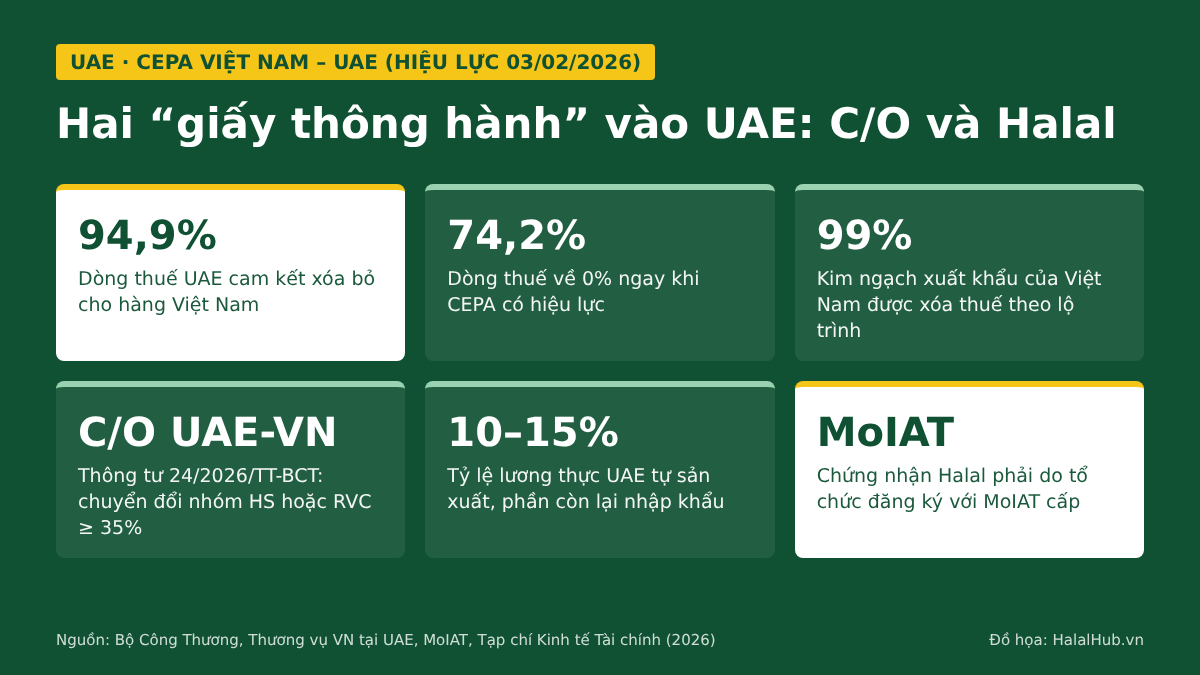
The Vietnam – UAE CEPA was signed on 28 October 2024 and entered into force on 3 February 2026. It is Vietnam’s first free trade agreement with an Arab country. According to figures published by the Ministry of Industry and Trade and the press, the UAE has committed to eliminating tariffs on 94.9% of tariff lines for Vietnamese goods, 74.2% of them immediately upon entry into force. By value, 99% of Vietnam’s exports to the UAE will become duty-free over 5, 10 or 15 years depending on the product group. For many agricultural and food products, duties fall from 5% to 0%, a clear price advantage over competitors without an FTA with the UAE.
To qualify for preferences, goods must meet the rules of origin under Circular 24/2026/TT-BCT (effective 5 May 2026) and be accompanied by a Form UAE-VN certificate of origin (C/O). For goods that are not wholly obtained, the general criterion is a change in tariff heading at the 4-digit level (CTH) or a regional value content (RVC) of at least 35% of the ex-works price. Without a valid C/O, the shipment is subject to the standard MFN duty and loses the entire CEPA advantage.
2. The UAE: not just a market, but the “gateway” to the Gulf
According to the Vietnam Trade Office in the UAE, the UAE is Vietnam’s largest trading partner in the Middle East. In 2025, the UAE’s non-oil trade hit a record of about USD 1.03 trillion, up 24.6%, of which re-exports accounted for about USD 267 billion. This highlights the UAE’s role as a transit hub to the Gulf Cooperation Council (GCC) countries, Africa and South Asia.
Notably, the UAE produces only about 10–15% of its own food needs and relies on imports for the rest. This leaves ample room for Vietnamese fruit and vegetables, cashews, pepper, seafood and processed foods.
🔑 WHY DOES THE UAE MATTER?
A food import market with stable year-round demand.
A re-export hub: goods that enter the UAE can move on to Saudi Arabia, other GCC countries, Africa and South Asia.
A springboard for the Vietnam – GCC FTA (VGFTA), for which negotiations are being prepared, according to the Agency of Foreign Trade (Ministry of Industry and Trade).
3. The reality: preferences in place, results lagging
According to preliminary data from the Vietnam Trade Office in the UAE, in the first 6 months of 2026, fruit and vegetable exports to the UAE reached only about USD 35 million, down 41.88%; cashew exports fell by about 70.7% and pepper by about 50.2% year on year. Reasons cited include regional conflict pushing up war-risk insurance premiums, adjusted shipping schedules and longer delivery times. Vietnamese goods also face fierce competition from Brazil, Indonesia and China.
On the Halal side, according to figures cited by the domestic press, Vietnam’s Halal product exports amount to only about USD 700–900 million a year, and only about 0.2% of Vietnamese businesses have Halal-certified products. This is the very “bottleneck” preventing CEPA’s tariff preferences from turning into orders.
4. UAE Halal rules: what you must know
The UAE Halal system is managed by the Ministry of Industry and Advanced Technology (MoIAT), based on Cabinet Resolution No. 10 of 2014 on the UAE Halal Products Control System and the UAE.S 2055-1 standard (compatible with the Gulf’s GSO 2055-1). The core principle: products and ingredients must carry a Halal certificate issued by a certification body registered with MoIAT. These bodies must be accredited by an accreditation body approved by MoIAT, such as the Emirates International Accreditation Centre (EIAC).
- Meat and poultry: a valid Halal certificate is mandatory for every shipment.
- Food in general: according to the Vietnam Trade Office in the UAE, food without a valid Halal certificate from a body recognised by the host country will not clear customs.
- UAE national Halal mark: issued by MoIAT after conformity assessment. It is voluntary but carries high commercial value on the shelf.
⚠️ WARNING: CHECK REGISTRATION VALIDITY
MoIAT’s list of registered certification bodies shows expiry dates and is updated continuously. A body may once have been accepted but its registration may since have expired. Before every contract, businesses should look up the “Registered Halal Certification Bodies” section on the MoIAT portal (moiat.gov.ae) directly and check the body’s name, product scope and “Active” status.
5. Two “passports”: a quick comparison
| Criterion | Form UAE-VN C/O | Halal certificate |
|---|---|---|
| Purpose | Obtain CEPA preferential duties (0% or per the phase-out schedule) | Clear customs, circulate and sell to Muslim consumers |
| Legal basis | CEPA; Circular 24/2026/TT-BCT | Cabinet Resolution 10/2014; UAE.S 2055-1 |
| Issuing body | C/O-issuing agencies and organisations in Vietnam as regulated by the Ministry of Industry and Trade | Halal certification body registered with MoIAT |
| If missing? | MFN duty applies, price advantage lost | Customs clearance may be refused |
Source: compiled by HalalHub.vn. Businesses should check the original documents before acting.
6. A 6-step roadmap for businesses exporting to the UAE
- Identify the HS code and CEPA tariff rate of your product in the 2026 preferential tariff schedule to calculate your price advantage.
- Review the rules of origin under Circular 24/2026/TT-BCT, calculate the RVC or check the tariff-shift criterion.
- Choose a Halal certification body with “Active” status on MoIAT’s list and the right product scope.
- Standardise your factory and supply chain: Halal assurance system, ingredient traceability and Arabic labelling as required by the UAE.
- Work with your UAE importer on product registration, labelling and customs documentation.
- Account for all logistics costs and risks: insurance, shipping schedules and delivery times amid regional volatility.
✅ THE HALALHUB VIEW
CEPA solves the tariff problem; Halal certification solves the market problem. Businesses that prepare both early will enjoy a double advantage when the Vietnam – GCC FTA is negotiated, as the UAE is the gateway to the entire Gulf region.
🛒 HALALHUB.VN – THE GATEWAY FOR VIETNAMESE GOODS INTO THE GLOBAL HALAL MARKET
Importers in the UAE and the Gulf are always looking for suppliers that are certification-ready with transparent documentation.
Open a storefront on HalalHub.vn to showcase your products, Halal certificates and export capacity to international buyers. Register now at https://halalhub.vn
Glossary
- CEPA (Comprehensive Economic Partnership Agreement): a type of free trade agreement.
- C/O (Certificate of Origin): Form UAE-VN is used to claim tariff preferences under CEPA.
- Tariff line: a single product code in an import tariff schedule.
- MFN duty (Most Favoured Nation): the standard duty rate applied to goods from WTO members, higher than FTA rates.
- CTH (Change in Tariff Heading): an origin criterion based on a change in the 4-digit HS heading.
- RVC (Regional Value Content): the share of value created within the member countries of an agreement.
- MoIAT (Ministry of Industry and Advanced Technology): the UAE ministry that manages the Halal system.
- EIAC (Emirates International Accreditation Centre): assesses the competence of certification bodies.
- UAE.S 2055-1 / GSO 2055-1: UAE / Gulf standards on general requirements for Halal food.
- GCC (Gulf Cooperation Council): comprising the UAE, Saudi Arabia, Qatar, Kuwait, Oman and Bahrain.
- VGFTA: the Vietnam – GCC Free Trade Agreement (negotiations being prepared).
References
- Economic & Finance Review – UAE opens nearly 95% of tariff lines: wide door for Vietnamese goods into a USD 4 trillion market (Vietnamese)
- Economic & Finance Review – Export opportunities for key product groups to the Middle East (Vietnamese)
- Vietnam Financial Times – Ministry of Industry and Trade issues rules of origin implementing the Vietnam – UAE CEPA (Vietnamese)
- Bao Tin tuc (VNA) – Leveraging CEPA to open the way for Vietnamese farm produce into the UAE (Vietnamese)
- WTO Center – VCCI – Mitigating the impact of Middle East conflict, leveraging CEPA to secure a position in the UAE market (Vietnamese)
- VOV – A trillion-dollar Halal market, yet Vietnamese farm exports reach only USD 700 million (Vietnamese)
- Bao Dau tu – Halal exports reach only USD 700–900 million a year, ample room for businesses (Vietnamese)
- MoIAT – Halal Program · Registered Halal Certification Bodies
Photos: Unsplash (Unsplash licence). Graphics: HalalHub.vn.