HalalHub.vn · In-depth analysis · 29 October 2026
(HalalHub.vn) – A business may hold Halal certification yet still have its shipment rejected. The cause often lies not in the product, but in the issuing body not being recognized by the importing country. This article summarizes recognition across five key markets as of October 2026 and proposes five checks before signing a certification contract.
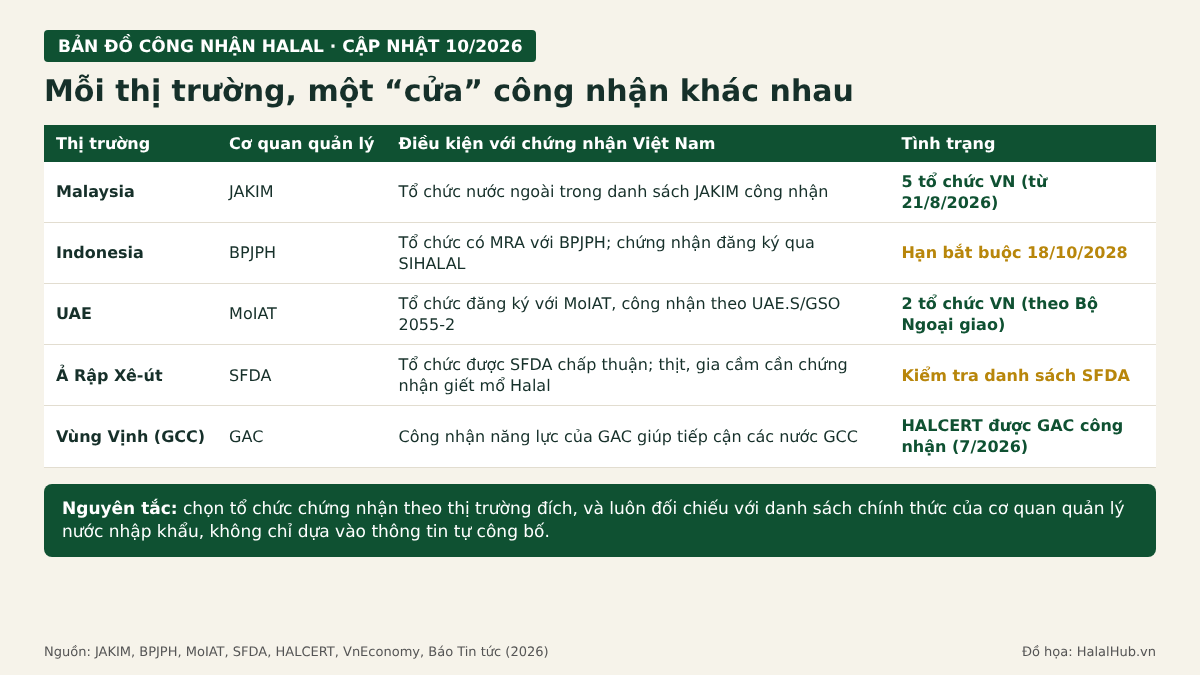
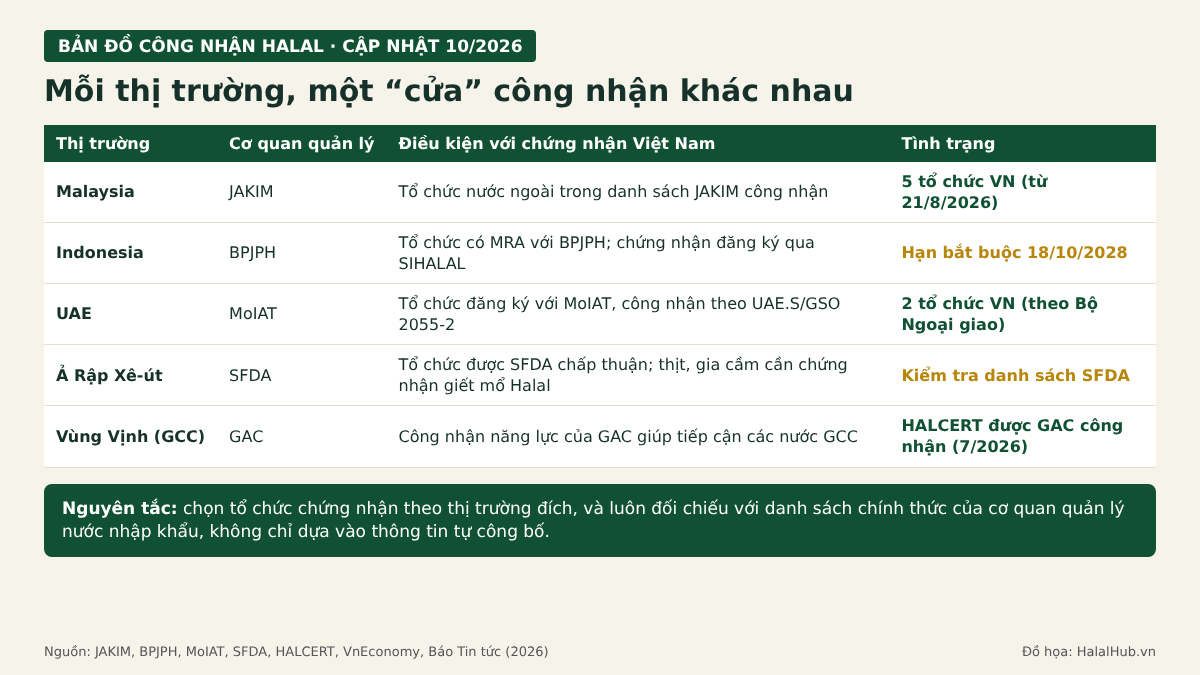
Recognition of Vietnamese Halal certification across five markets, updated October 2026. Graphic: HalalHub.vn.
1. Why holding a certificate is not enough
There is no single global Halal authority. Each major importing country develops its own system and decides which foreign bodies’ certificates it accepts. A certificate valid in Malaysia may not be accepted in the UAE, and vice versa. Recent reporting on Vietnam’s Halal exports consistently highlights the same bottleneck: standards and certification systems are not harmonized across markets.
The relevant question is therefore not simply whether a product is Halal-certified, but whether that certificate is recognized in its destination market.
2. The picture by market
Malaysia: The clearest picture
Since 21 August 2026, JAKIM has recognized five Vietnamese Halal certification bodies: Halal Certification Agency (HCA), Halal Vietnam (HVN), Vietnam National Halal (VNH), Halal Certification and Assessment (VINAHIC), and Global Halal Certification (GHC). According to Viet Nam News, with five bodies Vietnam ranks third by number of JAKIM-recognized bodies, behind Australia and Japan.
Indonesia: More time, but the right choice matters
Under PP 40/2026, imported food and beverages must have Halal certification from 18 October 2028. This deadline is linked to completing mutual recognition agreements (MRAs) between BPJPH and foreign bodies; certificates must also be registered through SIHALAL. Businesses should consult BPJPH’s official list of foreign bodies with MRAs.
UAE: Only bodies registered with MoIAT are accepted
The UAE requires certificates issued by bodies registered with the Ministry of Industry and Advanced Technology (MoIAT). According to Bao Tin Tuc’s report on the third political consultation between the two foreign ministries, two Vietnamese certification bodies are currently recognized by the UAE, which is willing to cooperate on adding more. Vietnam–UAE CEPA tariff preferences deliver value only when certification meets this condition.
Saudi Arabia and the Gulf: An additional check is needed
The Saudi Food and Drug Authority (SFDA) sets its own Halal certification requirements, including Halal slaughter certification for meat and poultry. Across the Gulf Cooperation Council (GCC), Vietnam’s National Halal Certification Center (HALCERT) received accreditation from the GCC Accreditation Center (GAC) in July 2026, an important step toward wider access for Vietnamese certification in GCC countries.

Factory assessment is a mandatory step in Halal certification, but a certificate’s value also depends on whether the issuing body is recognized in the destination market. Illustrative photo: Unsplash.
3. Be cautious about self-reported recognition
| ⚠️ IMPORTANT NOTE Many certification bodies state on their websites that they are recognized by multiple international authorities. These are self-reported claims. Before signing a contract, businesses must cross-check the importing country’s official regulatory lists, which may change as bodies are added, suspended or removed. |
Recognition may cover only certain product categories, such as processed food but not slaughter. A body’s presence on a list does not necessarily mean it is recognized for the business’s particular products.
4. Five checks before signing a certification contract
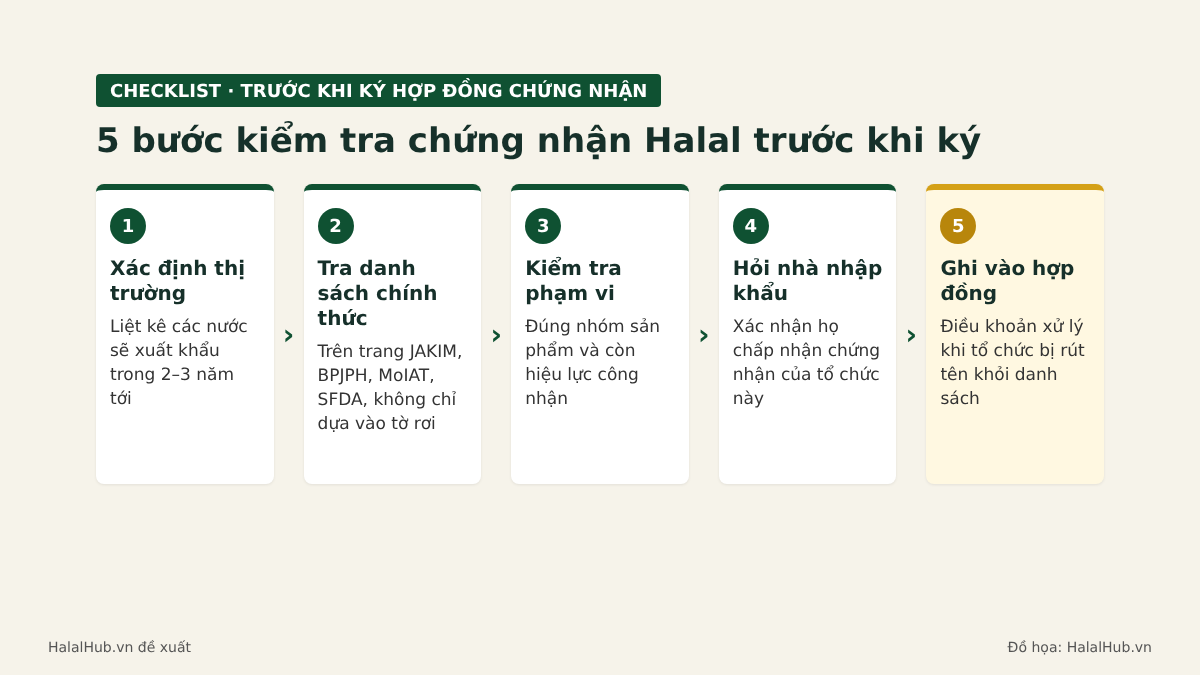
Five checks before signing a Halal certification contract. Graphic: HalalHub.vn.
Identify destination markets for the next two to three years, since recertification for a new market usually costs more than choosing correctly at the outset.
Check official JAKIM, BPJPH, MoIAT and SFDA lists instead of relying solely on promotional material.
Verify that the scope and validity of recognition cover the business’s specific product category.
Ask the importer whether it has previously cleared goods carrying certification from this body.
Include a contract clause defining the certification body’s responsibility if it is removed from a recognition list.
5. Conclusion
Choosing a certification body is a market decision as well as a technical procedure. Vietnam’s recognition map is expanding quickly: five bodies in Malaysia, two in the UAE, HALCERT’s GAC accreditation, and the MRA timeline with Indonesia through 2028. Businesses that understand this map can avoid rejected shipments and recertification costs.
Glossary
Recognition: acceptance by the importing country’s Halal authority of certification issued by a foreign body.
MRA: mutual recognition agreement between two authorities or certification bodies.
JAKIM / BPJPH / MoIAT / SFDA: the Halal regulatory authorities of Malaysia / Indonesia / the UAE / Saudi Arabia.
GAC: GCC Accreditation Center, which assesses certification body competence for GCC countries.
HALCERT: Vietnam’s National Halal Certification Center.
Scope of recognition: the product and service categories for which a body may issue certification accepted in a particular market.
References
Legal texts and official sources
MoIAT – Registered Halal Certification Bodies
SFDA – Halal Certificate Requirements
Press and industry analysis (secondary sources, cited as published)
VnEconomy – Malaysia recognises five Vietnamese Halal certification bodies
Viet Nam News – Việt Nam has five Halal certification bodies recognised by Malaysia
Bao Tin Tuc – Third political consultation between the foreign ministries of Vietnam and the UAE
Vietnam Financial Times – Expanding export opportunities in Halal markets
Dai Doan Ket – Opening the Halal gateway and increasing the value of Vietnamese exports
Illustrative photo: Unsplash (Unsplash License). Graphics: HalalHub.vn.
HalalHub.vn · Published on 29 October 2026 · Legal information checked as of 29 October 2026; regulations may change. Consult official sources before making decisions.
| ℹ️ ABOUT HALALHUB.VN’S INDEPENDENCE HalalHub.vn is a platform for connections and information. HalalHub.vn is not a Halal certification body and does not issue Halal certificates. Halal certificates are issued by bodies recognized by the competent authority in the importing country (for example, BPJPH in Indonesia and bodies recognized by JAKIM in Malaysia). This article is for reference and does not replace legal advice. |
HalalHub.vn service information
| 🤝 CONNECT WITH HALALHUB.VN Already Halal-certified: register and create a business profile in the HalalHub.vn directory, specifying the issuing body, scope and validity of your certificate so partners can assess it. Not yet certified: follow HalalHub.vn’s News and Knowledge sections for regulatory updates and certification roadmaps for each market. Register at: https://halalhub.vn |